

How to Learn the BTS DNA Dance: Step-by-Step Tutorial and Tips
Published on April 2026
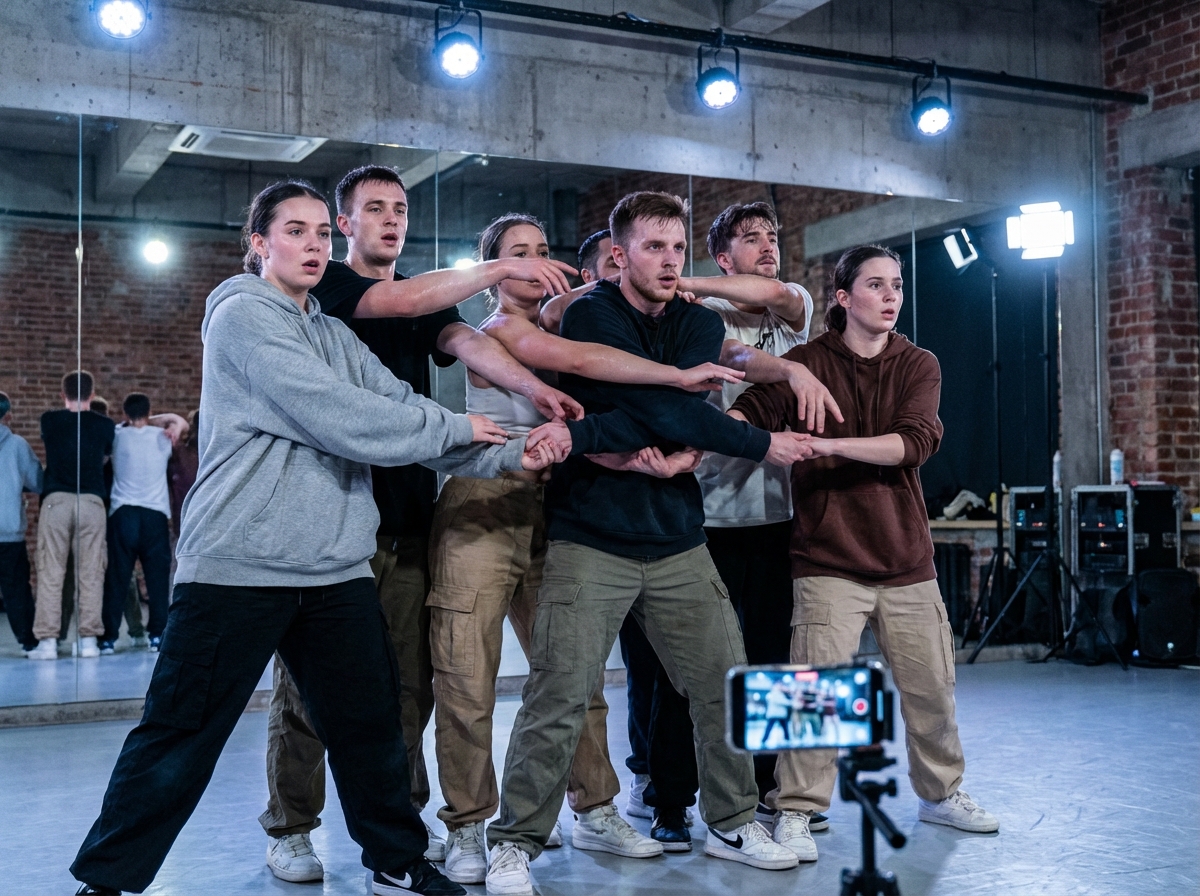
BTS DNA is one of the most enduringly searched K-pop choreographies, and one of the most technically demanding for solo learners. The original choreography is designed for seven members dancing in formation — which means recreating it solo requires significant adaptation, and learning it by mirroring a single member requires choosing whose part you are following and staying consistent.
This guide identifies the most technically demanding sections and gives you a structured approach to breaking them down.
Choose Your Member Before You Start
The most common confusion when learning BTS DNA as a solo dancer is trying to follow the group as a whole. The formation changes constantly, which means the "centre" of the shot changes and the visual reference point shifts throughout the video. Before you watch a single tutorial, decide whose part you are learning — most solo cover dancers follow Jungkook (centre, most screen time) or Jimin (the most technically distinctive movements). Commit to one and find a version of the MV or a performance where your chosen member is most visible.
The Three Highest-Difficulty Sections
The spiral sequence in the intro. The arm spirals that open the choreography look fluid in the original because they are built on continuous circular momentum — the arm does not stop at the end of each circle before beginning the next. Most learners add a pause at each position, which breaks the flow. Practise the arm movement isolated, at very slow speed, focusing on continuity of motion rather than position accuracy.
The chorus footwork. The footwork pattern in the chorus combines lateral steps with quick direction changes and requires weight to shift completely and quickly. The most common error is an incomplete weight transfer on the direction changes — one foot stays partially weighted, which creates a shuffle quality instead of the clean directional changes in the original.
The rap verse body movement. The body movement during the rap verses (the forward-and-back chest movement combined with the lateral footwork) requires simultaneous upper and lower body independence that is harder than it looks. Learn the footwork completely first, then layer the upper body movement in, rather than trying to learn both simultaneously.
Using AI Comparison for K-Pop Precision
K-pop choreography is unusually learnable via AI comparison because the original is a fixed, high-quality reference — you are not trying to match a general style, you are trying to match specific positions on specific beats. Load the DNA MV as your reference in DanceBetter, upload your practice clip, and the AI identifies frame by frame where your version diverges. This is dramatically faster than self-assessment.
Upload Your BTS DNA Practice Video →
Also learning other K-pop covers? Read our K-pop dance guide →